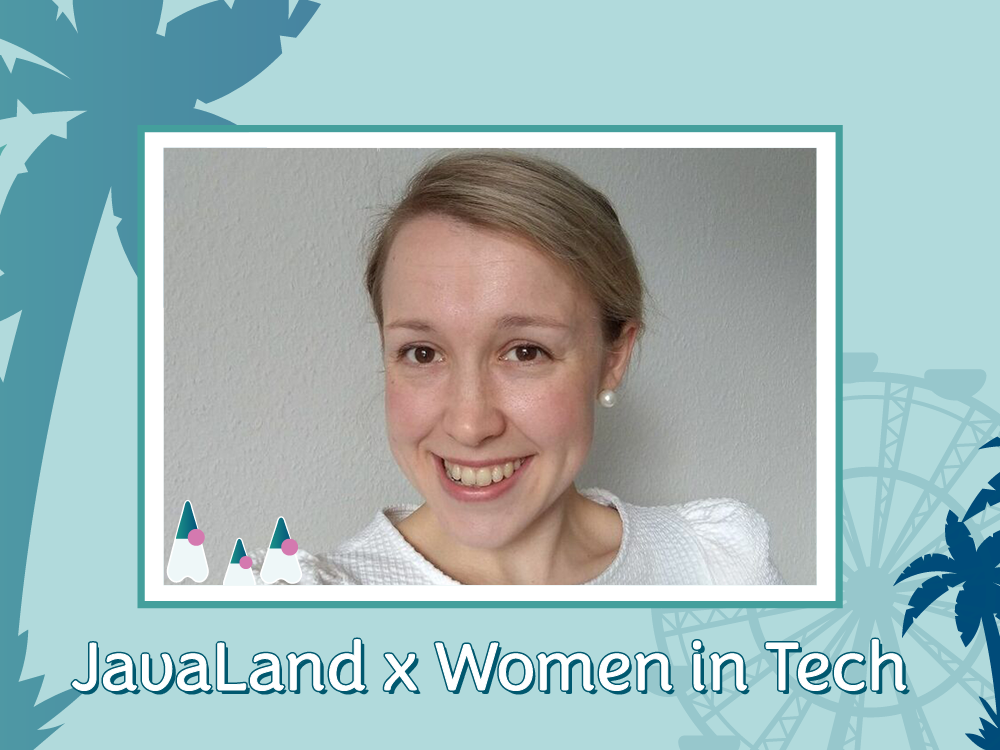
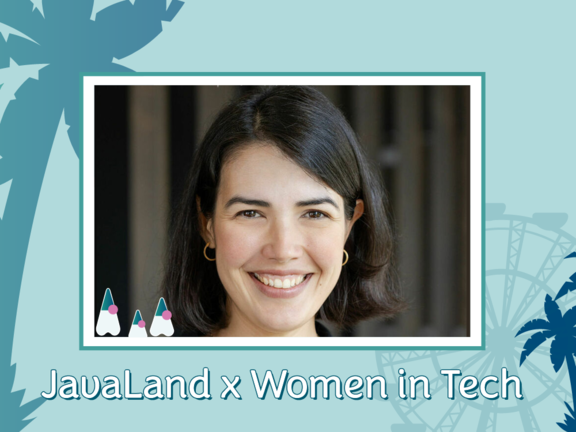
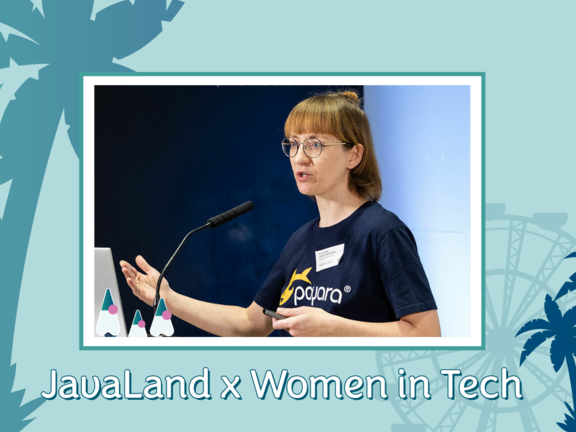
For the JavaLand x Women in Tech series, Ixchel Ruiz has interviewed female speakers of the upcoming JavaLand 2026 at Europa-Park. These speaker spotlights give you the opportunity to get to know the speaker better and get their valuable input and insight on current topics. You can find more background information regarding the Women in Tech movement as well as Ixchel's motivation behind it in our previous article.
Session Title:KI + AST + ESLint = Codequalität auf dem nächsten Level
Time: Tuesday, March 10 | 11:00 – 11:40
Room: Bellevue
Language: German
Focus: Quality & Testing
AI is everywhere right now. It writes tests. It generates code. It even drafts documentation. But beyond the buzzwords, how does it truly help with everyday development?
In her session, Milena Fluck starts with a practical question: how can AI meaningfully support developers in improving code quality?
Rather than making abstract promises, she and her colleague Andy Schmidt present a concrete use case. Together, they developed a small tool called Lint-E, which uses AI in the background to speed up the creation of custom ESLint rules.
Meet the Speaker: Milena Fluck
Milena Fluck, who works at adesso SE, has made JavaLand a yearly tradition. For her, the conference is a technical highlight and an opportunity to reconnect with the community.
In this session, she joins forces with Andy Schmidt to explore four key topics: linting, prompt engineering, foundation models and abstract syntax trees. Although AI plays an important role, the talk will not focus on hype. Instead, Milena demonstrates where AI genuinely adds value and where human expertise is still necessary.
Why Milena Brought This Conversation to JavaLand
Maintaining high code quality is essential, yet standard lint rules often fail to account for project-specific conventions. While custom ESLint rules solve this problem, writing them manually requires an in-depth understanding of abstract syntax trees and ESLint’s internal architecture.
Milena and Andy propose a more efficient approach. By combining AI models with a solid understanding of ASTs, they demonstrate how custom lint rules can be generated more quickly and with less repetitive effort.
At the same time, the talk goes deeper than AI alone. It delves into the technical foundation of linting and compiling, which is based on ASTs. Even sceptical attendees will gain practical insight into how ASTs work and why they matter.
The aim is not to replace developer expertise, but to supplement it.
The One Idea She Wants You to Take Home
Although AI can produce fast results, it does not replace technical understanding.
Milena’s central message is that the effective use of AI requires a strong grasp of the relevant field. Developers are still responsible for identifying the real problem, framing it clearly and validating the solutions produced by an AI system.
Regardless of whether we view AI agents as tools, algorithms, or collaborators, their effectiveness hinges entirely on our interaction with them and our grasp of the underlying models and problem.
AI does not remove the need for expertise. It simply amplifies the impact of those who possess it.
Her Perspective: Brilliance Over Conformity
Milena draws inspiration from a quote by Chimamanda Ngozi Adichie:
'We raise girls to see each other as competitors, not for jobs or accomplishments — which, in my opinion, can be a good thing — but for the attention of men.'
She reflects on how the competition for attention has changed in the tech industry. Nowadays, AI agents are often regarded as the new 'star performers' in decision-making spaces. In some countries, investments in machine learning now rival or even exceed investments in human education. Sometimes it feels as if machines are granted more of a 'right' to be developed than certain groups of people.
Her perspective is clear: we have intelligent, creative human minds with values, ideas and ambition that remain underutilised. Women have only recently started to gain ground in tech, yet there is already a narrative suggesting that parts of the workforce might be replaced by more controllable systems.
Her message to women in tech is powerful:
AI may replace standard programming tasks, but brilliant computer scientists will always be needed. Women in tech have never had the luxury of being average. They have always had to be exceptional.
Milena believes that AI will amplify human excellence, not replace it. Women in tech are uniquely positioned to shape that future by being recognised for their brilliance, not by conforming.
Why JavaLand Is the Right Place for This Talk
For Milena, JavaLand is about both technology and people. She is looking forward to reconnecting with familiar faces, meeting new ones, enjoying engaging discussions, and experiencing the unique atmosphere of Europa-Park.
She also looks forward to the keynote, which is often a highlight for her, and to conversations that extend beyond the session itself.
Join the Conversation
This session invites you to rethink how AI fits into your development workflow.
If you care about code quality, want to understand abstract syntax trees more deeply, or are curious about how AI can support but not replace engineering expertise, this talk offers practical insight and thoughtful reflection.
Bring your curiosity and your critical thinking to JavaLand 2026, and explore how AI and human expertise can work together to elevate code quality.
This article’s grammar and syntax were refined using ChatGPT and DeepL. The content reflects the speaker’s ideas, hopes, and statements.